This is it! My final post (*sniff*)! I've organized this approximately according to the expected learning outcomes, which I have given as headings. Not everything fits perfectly beneath its heading, and sometimes if a post matches two heading I only link to it once, but I think it will be close enough for jazz, as they say.
History, Concepts
Monday, April 16, 2012

Saturday, April 14, 2012
Free
A few examples of a few different kinds of free. Related to the business chapter of the ebook, but I wasn't able to transition into these examples smoothly.
Jell-O--have you ever looked at how Jell-O is made? Where gelatin actually comes from? It's quite gross.
Jell-O--have you ever looked at how Jell-O is made? Where gelatin actually comes from? It's quite gross.
Tuesday, April 10, 2012
Invitations and invitees
And here's my own little foray into the adventure of inviting people.
First, I posted the flier to my facebook timeline and invited everyone there to watch the live stream online. Then I started individually talking to people. I did invite ten people (and then a few more), and a few of the more interesting ones are posted below:
First, I posted the flier to my facebook timeline and invited everyone there to watch the live stream online. Then I started individually talking to people. I did invite ten people (and then a few more), and a few of the more interesting ones are posted below:
Saturday, April 7, 2012
Authors, Authority and Authenticity (but mostly the first two)
This is a short reflective post about this class, and not my final reflective post. I've been working on this for a few weeks and just realized I never posted it.
One thing that has bothered me for a long time about schools and education is the way that we are encouraged to think for ourselves, and then denied the opportunity. We are taught, not to synthesize, but to summarize. I'm sure most of us have been in classes where we were supposed to research an assigned topic, then take quotes and ideas from "real" authors (sometimes we are even told what authors to use), summarize them on paper, and turn in our own work*.
One thing that has bothered me for a long time about schools and education is the way that we are encouraged to think for ourselves, and then denied the opportunity. We are taught, not to synthesize, but to summarize. I'm sure most of us have been in classes where we were supposed to research an assigned topic, then take quotes and ideas from "real" authors (sometimes we are even told what authors to use), summarize them on paper, and turn in our own work*.
Saturday, March 24, 2012
The Fall of Modern Institutions?
I have a flair for the dramatic, or had you noticed?
Clay Shirky, in his book, makes some very bold statements, which I have recorded below. This might be it for our modern institutions and businesses...well, maybe.
Clay Shirky, in his book, makes some very bold statements, which I have recorded below. This might be it for our modern institutions and businesses...well, maybe.
Friday, March 23, 2012
Annotated...videography?
So, this is mostly for the business group, but if anybody else is interested in business-related videos and TED talks, you might find this interesting, too. I'll make this public for anyone interested, just in case. Here are a couple of Ted talks and other videos on business I've been looking at.
I don't know everyone else's content as well as my own, so I'm going to need your help. Do you want something like what you see below, just a brief clip of somebody talking about such and such a part of business? Or do you want something more like the video we saw in class of the man using the internet to help people in his village in Africa? I'm pretty confident I can find things, but it will be a lot easier if I have more direction.
This link connects to about a hundred ted talks on the subject of 'something other than business as usual'; if you just browse and read the titles, you might find something that you like or that is related to your topic. For example, I found this video; the section from 1:10 to 1:35 and especially the bit from 11:30 to 12:10 are great for my section of the chapter. He discusses the key concepts of 'free', which is exactly what I'm writing about. Also, this shorter video, by the same speaker is interesting, especially the part after 2:15 where he talks about people giving content away and discusses the ideas of non-monetary economies.
So, that's the best of what I have, right now. Is this what we're looking for? Do you have things you'd like to suggest? I'm absolutely open to suggestions.
I don't know everyone else's content as well as my own, so I'm going to need your help. Do you want something like what you see below, just a brief clip of somebody talking about such and such a part of business? Or do you want something more like the video we saw in class of the man using the internet to help people in his village in Africa? I'm pretty confident I can find things, but it will be a lot easier if I have more direction.
This link connects to about a hundred ted talks on the subject of 'something other than business as usual'; if you just browse and read the titles, you might find something that you like or that is related to your topic. For example, I found this video; the section from 1:10 to 1:35 and especially the bit from 11:30 to 12:10 are great for my section of the chapter. He discusses the key concepts of 'free', which is exactly what I'm writing about. Also, this shorter video, by the same speaker is interesting, especially the part after 2:15 where he talks about people giving content away and discusses the ideas of non-monetary economies.
So, that's the best of what I have, right now. Is this what we're looking for? Do you have things you'd like to suggest? I'm absolutely open to suggestions.
Wednesday, March 21, 2012
The Changing Business Landscape: An Annotated Bibliography
Further Reading:
·
Shirky, Clay. (Here Comes Everybody: The Power of
Organizing Without Organizations.
Penguin Group, 2009). Discussion
with useful examples of important social changes being caused by advancing
technology. It deals especially with the
enhanced opportunity to cooperate and collaborate created by the internet via such
means as crowdsourcing. [I was assigned
to read this book for class]
·
Chris Anderson. (Free: The Future of a Radical Price,
Hyperion Publishing, 2009). Discusses
the history, present reality, and future of free business models. It is based in economic theories and
evidence, but is still written in clear, easy language. Free also
discusses the idea of a new industrial revolution. [This book was recommended to me by Professor
Burton, and I have also run into it several times in the bibliographies of
business articles I’ve been reading]
·
Charles Wheelan. (Naked Economics: Undressing the Dismal
Science, Norton Publishing, 2010).
In the introduction and the first chapter, he gives some very good
examples of businesses that have successfully used ‘free’ campaigns in the
past. Throughout the book, he also gives
a good background of economic principles, many of which are implied in the text
of the business chapter. [I read this for an economics class last year. When I saw it cited in a different book, it
motivated me to pull it off the shelf and dive into it again.
·
David J. Bryce, Jeffrey H.
Dyer, and Nile W. Hatch. (Competing Against Free. Harvard Business Review, June 2011). An interesting article that gives credit to
Chris Anderson’s Free, by presenting
the business plans necessary to combat competitors using free tools or business
models. It makes and supports the claim
that “sooner or later, every business must learn to compete against, become, or
work with free business models.” [Found while I was researching anti-free
literature; I wanted to make sure I heard both sides of the issue and stumbled
across this article.]
Thought Leaders:
·
Muhammed Yunus (http://www.muhammadyunus.org/). Muhammed
is an exceptionally well-known Bangladeshi business leader who received the
Nobel Prize in 2006 for his work in setting up his microcredit bank to improve
the Bangladeshi way of lifestyle. He is
also a noted economist, and seems very open to discussing ideas. [Mr. Yunus is a great example of how
businesspeople can accomplish amazing things for the social good, and happens
to be specifically noted in one of the examples we brought out in our chapter
(i.e. microloans)]
·
J Jay Baer (<co-author with
Amber Naslund> The Now Revolution: 7
Shifts to Make Your Business Faster, Smarter and More Social. Wiley
Publishing, 2010). Jay Baer is a
marketing consultant, speaker, and author, who focuses primarily on social
media strategy. He is naturally very
active on various social media, so he would be easy to contact to discuss
ideas. [Found using a google+ search to
find conversations I could join].
·
Denise Wakeman (http://www.buildabetterblog.com/). Denise is a business professional who
maintains several blogs giving instruction about how to effectively incorporate
blogs into a business strategy.
Professionally, she also advises businesses on how to make themselves more
visible to the public via social media and other internet sources. She is very active on several social media websites,
so it would relatively easy to contact her, as well. [Found while searching for business blogs on which I could comment.]
Tuesday, February 28, 2012
Saturday, February 25, 2012
Through a reflection, darkly...
Okay, so as per instructions, I've taken the time to read my blog posts and respond...to myself. I was, indeed a little surprised at what I found. Below are excerpts, descriptions, and conclusions from a few of my blog posts that I felt best illustrated the direction I've started taking.
Monday, February 6, 2012
Consider the Source, Luke. Always.
Okay, this is funny, but truly something I think we can all work on...
 Participation and Crowd Sourcing are wonderful things, and the web is a great tool for memory extension as well as accelerated learning, but there is an inherent danger any time people collaborate to "decide upon truth."
In my business computers class last semester, we discussed the idea of 'Wikiality'. Coined by Stephen Colbert, it was defined by Business-Driven Technology (McGraw-Hill, Irwin) as "The truth we can all agree upon." People believe how and what they want to believe, and they act on what they believe; that doesn't make it true, and yet at the level that it can be observed, it becomes true.
Silly example: let's just say people believe that politician X sold American secrets, or voted to outlaw childbirth, or some other despicable crime (let's be honest, if you look at some of the campaign propaganda lately, this isn't far from the truth). If the electorate believes that he is a despicable person, it doesn't matter what the truth is; he won't get elected! This is one of the potential problems with openness and easy participation. Misinformation is a dangerous, yet effective, weapon, that only gets worse as more people get their hands on it.
Like the comic suggests, it isn't just politicians attacking each other that creates misinformation; anyone editing a Wiki or writing their own page has the potential to misinform, intentionally or not. Like Abraham Lincoln said, it's hard to trust purely web-based sources; I'll admit that I do lots of fact-checking online, but it's a dangerous game to play with our information.
*somewhat random interjection: my favorite wikipedia page:* http://en.wikipedia.org/wiki/List_of_common_misconceptions
Here are some things that I do to help avoid believing and spreading false information. Input about this short list is more than welcome.
First, does it make sense? I remember once when a friend told me he wouldn't read Harry Potter, because he heard that "over 100 million kids are worshiping the devil because of those books!" Since Harry Potter has sold about 400 million copies, according to ABC; so every fourth book has convinced someone to worship the devil?
Second, are there sources? I know there are better ways of researching things than a simple Google search, and yet if you can't find *anything* about a significant story there, it's probably worth questioning.
Third, for rumors, snopes.com and other similar sites do good research and include print and online sources, which adds a lot of credibility. True, print isn't a perfect medium, but if enough books say the same thing...ah, but now I'm falling into my own trap, aren't I?
Well, it's hardly a complete list, but it's a good foundation for deciding whether a claim is credible or not. To conclude, I'll leave you with a motivational thought:


In my business computers class last semester, we discussed the idea of 'Wikiality'. Coined by Stephen Colbert, it was defined by Business-Driven Technology (McGraw-Hill, Irwin) as "The truth we can all agree upon." People believe how and what they want to believe, and they act on what they believe; that doesn't make it true, and yet at the level that it can be observed, it becomes true.
Silly example: let's just say people believe that politician X sold American secrets, or voted to outlaw childbirth, or some other despicable crime (let's be honest, if you look at some of the campaign propaganda lately, this isn't far from the truth). If the electorate believes that he is a despicable person, it doesn't matter what the truth is; he won't get elected! This is one of the potential problems with openness and easy participation. Misinformation is a dangerous, yet effective, weapon, that only gets worse as more people get their hands on it.
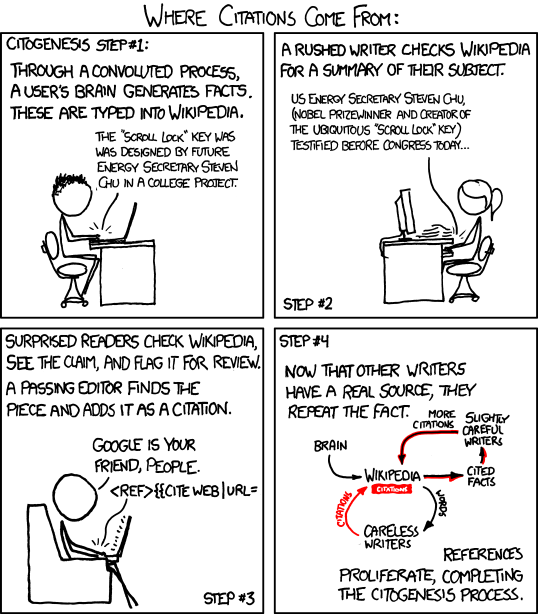 |
| credit to xkcd.com |
*somewhat random interjection: my favorite wikipedia page:* http://en.wikipedia.org/wiki/List_of_common_misconceptions
Here are some things that I do to help avoid believing and spreading false information. Input about this short list is more than welcome.
First, does it make sense? I remember once when a friend told me he wouldn't read Harry Potter, because he heard that "over 100 million kids are worshiping the devil because of those books!" Since Harry Potter has sold about 400 million copies, according to ABC; so every fourth book has convinced someone to worship the devil?
Second, are there sources? I know there are better ways of researching things than a simple Google search, and yet if you can't find *anything* about a significant story there, it's probably worth questioning.
Third, for rumors, snopes.com and other similar sites do good research and include print and online sources, which adds a lot of credibility. True, print isn't a perfect medium, but if enough books say the same thing...ah, but now I'm falling into my own trap, aren't I?
Well, it's hardly a complete list, but it's a good foundation for deciding whether a claim is credible or not. To conclude, I'll leave you with a motivational thought:

Saturday, February 4, 2012
Playing Chess: Here Comes the WORLD
Chess. It's one of my many sins. Don't think I'm nerdy enough for it? Fine, here's a picture:
 |
| That's me. And that's my state championship trophy. Believe me yet? |
Saturday, January 28, 2012
Losing a Sidekick
In the book about participation I'm reading for class, I found an interesting paragraph about the pros and cons of our new way of connecting ourselves, as demonstrated in the story I linked to earlier (here it is again). Briefly recapped, a woman lost her phone in a cab, a teenage girl picked it up and used it as her own. When the rightful owner tried to get it back, the teenage girl was exceptionally rude. A friend of the original owner posted their story online, and within a few weeks, he had over a million visitors to his website. People used social networking sites and other resources, on- and off-line, to locate the girl and get all of her information, which they posted to the website. In the end, because of the media and web attention the story was getting, the NYPD was eventually persuaded to arrest the girl and the phone was returned to the original owner, despite originally deciding their officers' time could be better spent elsewhere.
 |
| The Sidekick--Not exactly the cutting edge anymore, but in '06 it was pretty expensive. |
In his book, Clay Shirky points out that this is a very exceptional case; we can't *all* get worked up every time someone loses a phone. It's also a new kind of experience; just five or so years earlier, neither the tools nor the social structures that the man used to get the phone back were in place. However, in spite of these obviously unique elements, this is a great example of what our new systems are capable of. But is that good for us?
First, we have to recognize that whether this is a good event or a bad event is a very subjective question. For Ivanna (the original owner), the story is mostly good, because she got her phone back. For her friend, it's a good thing as well, because he was able to use his social network, and his sense of justice and outrage at the mistreatment of his friend were adequately answered. For the girl, her boyfriend, and her family (who got dragged into the mess when she did), there isn't much good about this story at all. Sure, taking a phone isn't great behavior, but "who could have known that she was picking up a phone that had a million people at the other end?" (I didn't come up with that, it's in the book) Did she really deserve the ire of a million-person audience, with all their nasty commentary and invasions of privacy? Or an arrest out of the blue? Maybe, or maybe not.
 |
| Steal a phone...we're coming. |
From the book:
"And what about us? What about the society in which this tug-of-war was happening? For us the picture isn’t so clear. The whole episode demonstrates how dramatically connected we’ve become to one another. It demonstrates the ways in which the information we give off about our selves, in photos and e-mails and MySpace pages and all the rest of it, has dramatically increased our social visibility and made it easier for us to find each other but also to be scrutinized in public. It demonstrates that the old limitations of media have been radically reduced, with much of the power accruing to the former audience. It demonstrates how a story can go from local to global in a heartbeat. And it demonstrates the ease and speed with which a group can be mobilized for the right kind of cause. But who defines what kind of cause is right?"
Shirky, Clay (2009-02-24). Here Comes Everybody: The Power of Organizing Without Organizations (pp. 11-12). Penguin Group. Kindle Edition.
That isn't a tweethis, yet. But it's getting close. There's definitely discussion that needs to happen, about where this tremendous force goes and what it does, and who is in charge. I'll be posting later, but for now, I'll close with a question:

Tuesday, January 24, 2012
Learn like it's the twentieth century
This is something of a fun post. I wanted to try learning something in the style of my assigned historical period, sort of as a spin off from the projects in last semester's class. It was a little less exciting, maybe, but still interesting. More below.
 |
| The BYU library, where my little drama takes place. |
Friday, January 13, 2012
Response to class today
So, after class I had a few thoughts that I wasn't able to share, so I've taken the time to type it out and post it. Go ahead and let me know what you think!

Saturday, January 7, 2012
How Digitally Civilized *Am* I?
 |
| Just how "digitally civilized" am I? This should give you some idea. |
Okay, okay, it's not that bad, even if I feel that way sometimes. I'm fairly handy with computers and the internet, etc., and especially after all of the information systems classes I took last semester, I feel confident being active and contributing to lots of different 'digital media'. I like computers, I spend a lot of my time on them every single day, and so I naturally spend the time to know what I'm doing with them, and to know it well. I have to agree with Ariel in her recent blog post (here), though; future shock is scary, and it's happening much too frequently for comfort, to every single one of us. Today, I feel confident with facebook and blogger, and I'm learning google+ and goodreads. Ten years from now, though, I will probably be comfortable with something entirely different that doesn't exist yet, and learning how to use something even newer still (at least, if recent trends mean anything).
Subscribe to:
Posts (Atom)