Let's start with the images:
Tuesday, February 28, 2012

Saturday, February 25, 2012
Through a reflection, darkly...
Okay, so as per instructions, I've taken the time to read my blog posts and respond...to myself. I was, indeed a little surprised at what I found. Below are excerpts, descriptions, and conclusions from a few of my blog posts that I felt best illustrated the direction I've started taking.
Monday, February 6, 2012
Consider the Source, Luke. Always.
Okay, this is funny, but truly something I think we can all work on...
 Participation and Crowd Sourcing are wonderful things, and the web is a great tool for memory extension as well as accelerated learning, but there is an inherent danger any time people collaborate to "decide upon truth."
In my business computers class last semester, we discussed the idea of 'Wikiality'. Coined by Stephen Colbert, it was defined by Business-Driven Technology (McGraw-Hill, Irwin) as "The truth we can all agree upon." People believe how and what they want to believe, and they act on what they believe; that doesn't make it true, and yet at the level that it can be observed, it becomes true.
Silly example: let's just say people believe that politician X sold American secrets, or voted to outlaw childbirth, or some other despicable crime (let's be honest, if you look at some of the campaign propaganda lately, this isn't far from the truth). If the electorate believes that he is a despicable person, it doesn't matter what the truth is; he won't get elected! This is one of the potential problems with openness and easy participation. Misinformation is a dangerous, yet effective, weapon, that only gets worse as more people get their hands on it.
Like the comic suggests, it isn't just politicians attacking each other that creates misinformation; anyone editing a Wiki or writing their own page has the potential to misinform, intentionally or not. Like Abraham Lincoln said, it's hard to trust purely web-based sources; I'll admit that I do lots of fact-checking online, but it's a dangerous game to play with our information.
*somewhat random interjection: my favorite wikipedia page:* http://en.wikipedia.org/wiki/List_of_common_misconceptions
Here are some things that I do to help avoid believing and spreading false information. Input about this short list is more than welcome.
First, does it make sense? I remember once when a friend told me he wouldn't read Harry Potter, because he heard that "over 100 million kids are worshiping the devil because of those books!" Since Harry Potter has sold about 400 million copies, according to ABC; so every fourth book has convinced someone to worship the devil?
Second, are there sources? I know there are better ways of researching things than a simple Google search, and yet if you can't find *anything* about a significant story there, it's probably worth questioning.
Third, for rumors, snopes.com and other similar sites do good research and include print and online sources, which adds a lot of credibility. True, print isn't a perfect medium, but if enough books say the same thing...ah, but now I'm falling into my own trap, aren't I?
Well, it's hardly a complete list, but it's a good foundation for deciding whether a claim is credible or not. To conclude, I'll leave you with a motivational thought:


In my business computers class last semester, we discussed the idea of 'Wikiality'. Coined by Stephen Colbert, it was defined by Business-Driven Technology (McGraw-Hill, Irwin) as "The truth we can all agree upon." People believe how and what they want to believe, and they act on what they believe; that doesn't make it true, and yet at the level that it can be observed, it becomes true.
Silly example: let's just say people believe that politician X sold American secrets, or voted to outlaw childbirth, or some other despicable crime (let's be honest, if you look at some of the campaign propaganda lately, this isn't far from the truth). If the electorate believes that he is a despicable person, it doesn't matter what the truth is; he won't get elected! This is one of the potential problems with openness and easy participation. Misinformation is a dangerous, yet effective, weapon, that only gets worse as more people get their hands on it.
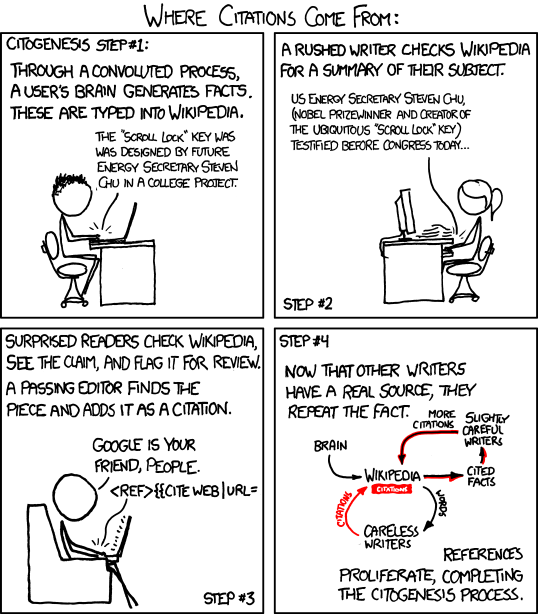 |
| credit to xkcd.com |
*somewhat random interjection: my favorite wikipedia page:* http://en.wikipedia.org/wiki/List_of_common_misconceptions
Here are some things that I do to help avoid believing and spreading false information. Input about this short list is more than welcome.
First, does it make sense? I remember once when a friend told me he wouldn't read Harry Potter, because he heard that "over 100 million kids are worshiping the devil because of those books!" Since Harry Potter has sold about 400 million copies, according to ABC; so every fourth book has convinced someone to worship the devil?
Second, are there sources? I know there are better ways of researching things than a simple Google search, and yet if you can't find *anything* about a significant story there, it's probably worth questioning.
Third, for rumors, snopes.com and other similar sites do good research and include print and online sources, which adds a lot of credibility. True, print isn't a perfect medium, but if enough books say the same thing...ah, but now I'm falling into my own trap, aren't I?
Well, it's hardly a complete list, but it's a good foundation for deciding whether a claim is credible or not. To conclude, I'll leave you with a motivational thought:

Saturday, February 4, 2012
Playing Chess: Here Comes the WORLD
Chess. It's one of my many sins. Don't think I'm nerdy enough for it? Fine, here's a picture:
 |
| That's me. And that's my state championship trophy. Believe me yet? |
Subscribe to:
Posts (Atom)